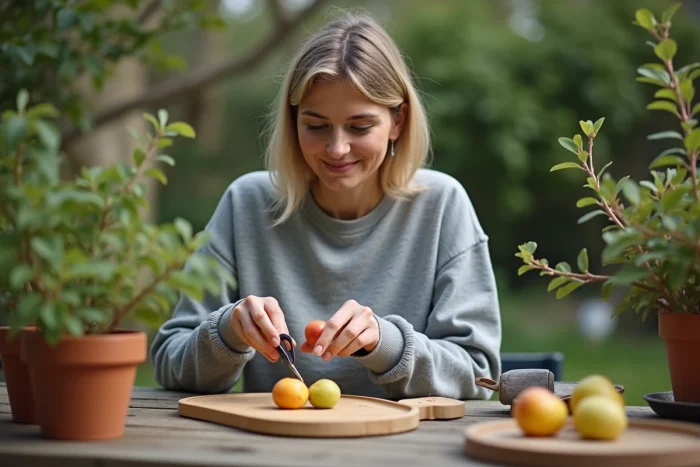
A cloned mirabelle tree from a cutting ensures that you will find the aroma, vigor, and generosity of the original tree. Unlike sowing, which plays with chance, cuttings promise genetic fidelity. However, success is never guaranteed in advance: everything depends on the choice of the branch, the season, and the care provided. Some varieties are easy to duplicate, while others are more temperamental and require constant attention. Too often, an unsuitable substrate or poorly controlled humidity undermines efforts. Success cannot be improvised: each step requires method and precision.
Why the mirabelle tree deserves to be multiplied at home
The mirabelle tree is not just another fruit tree. It embodies a part of Lorraine’s heritage, known for the consistency of its harvests and the unmatched flavor of its mirabelles. Choosing to multiply this plum tree at home is to perpetuate a tradition, but also to control the quality of its fruits. Cutting remains the safest method to reproduce the original variety, where sowing introduces a genetic gamble that can sometimes be disappointing.
There are many motivations: to obtain robust young plants, to ensure the continuity of a species that thrives locally, to avoid waiting years as with sowing or relying on a delicate graft. For many gardeners, it is also an opportunity to enrich their orchard, to renew fruit trees while protecting against diseases carried by poor rootstocks.
Taking a cutting from a mirabelle tree is not just a technical gesture: it involves observing the tree, choosing the right branch, timing it right, and adapting your actions to the plant’s development. To delve into every detail of the method, the page how to take a cutting from a mirabelle tree offers practical insights on multiplication. Taking a healthy branch, adjusting humidity, watching for emerging roots… every step counts to bring a new tree to life. Accessible with a bit of effort, cutting the mirabelle tree transmits concrete know-how and extends, season after season, the pleasure of harvesting your own fruits.
What are the ideal conditions to successfully take a cutting from a mirabelle tree?
First and foremost, you need to select a healthy stem that is vigorous, coming from a mother tree free of any disease. This initial choice determines the success of the cutting. Prefer a semi-woody stem with three or four nodes, 5 to 10 mm in diameter, and 15 to 25 cm long. The timing of the cutting is important: favor the dormant period (from November to December) or the very beginning of spring, when the sap starts to rise.
The substrate must be up to par: it should be light and draining, for example, a mix of potting soil, sand, garden soil, and a hint of peat. Use a pot with drainage holes to facilitate water evacuation: excess moisture is the number one enemy, synonymous with rotting roots or fungal diseases.
Light, diffuse but never scorching, supports the growth of the cutting. It is advisable to place the stem under a transparent plastic bag or in a mini-greenhouse to maintain stable humidity, which promotes root formation. This protection prevents drying out, provided you remember to ventilate regularly. An atmosphere that is too confined will always encourage mold.
To maximize your chances, dip the base of the stem in rooting hormone. Water lightly, keeping the substrate just moist, never soggy. The cutting should also be sheltered from wind and drastic temperature changes. Patience is required: depending on the temperature and care given, rooting can take several weeks or even a few months.

Key steps: successfully take a cutting from your mirabelle tree step by step
In the morning, when the sap flows gently, equip yourself with a clean, sharp pruning shear. Take a semi-woody branch of 15 to 25 cm, with three or four nodes. Cut cleanly at an angle just below a bud. Keep only two or three leaves at the top to limit evaporation.
Here is the step-by-step procedure to maximize your chances:
- Moisten the base of the stem, then dip it in rooting hormone to stimulate root formation.
- Prepare a clay pot with drainage holes, filled with a light substrate (a mix of special potting soil for cuttings and sand).
- Gently push the cutting in a few centimeters and lightly pack the substrate around the stem to hold it in place.
A light watering is necessary. Then cover the pot with a transparent plastic bag secured with a rubber band, or place it under a mini-greenhouse to retain moisture. Set everything in a light location, never in direct sunlight, to promote harmonious growth. Don’t forget to ventilate occasionally to avoid excess moisture, which is conducive to mold.
Watch for the emergence of young leaves: this is the signal that rooting is beginning to bear fruit. As soon as roots appear, gradually remove the protection and then transfer the plant to a larger pot or into the ground, sheltered from the wind. With method and consistency, a simple cutting transforms into a promising mirabelle tree. This gesture, repeated each season, gives rise to new trees and perpetuates the pleasure of home harvests.