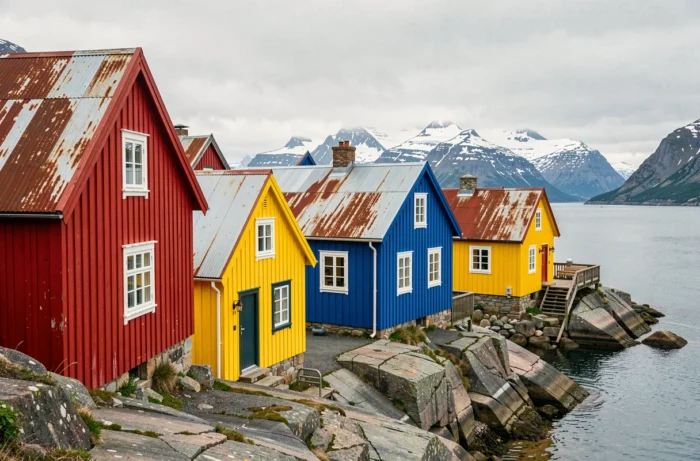
In Greenland, the facades of homes are painted in bright shades (red, blue, yellow, green) that stand out against the bare rock and snow. These colors are not the result of a recent decorative choice: they are part of a system inherited from Danish colonization, where each hue indicated the function of the building or the profession of its occupant.
Imported wood and painted cladding: the materials of Greenlandic houses
Greenland does not have exploitable forests. The wood used for exterior cladding is shipped from Denmark, a logistical constraint that affects all local construction. Before the arrival of Danish colonists, homes were made of earth, canvas, or snow, materials that were available on-site.
The introduction of prefabricated wood transformed the built landscape of the coast. Standardized Scandinavian houses, built on stilts to insulate the floor from permafrost, gradually replaced traditional structures. The paint applied to the cladding serves a dual purpose: it protects the wood from climatic aggressions (frost, saline humidity, strong winds) and makes each building identifiable in an environment that is often white or foggy.
This systematic reliance on an imported material explains why each house represents a considerable logistical investment. The cost of maritime transport to coastal villages weighs on the construction budget, which has long favored compact and repetitive models, differentiated primarily by the color of their facade.
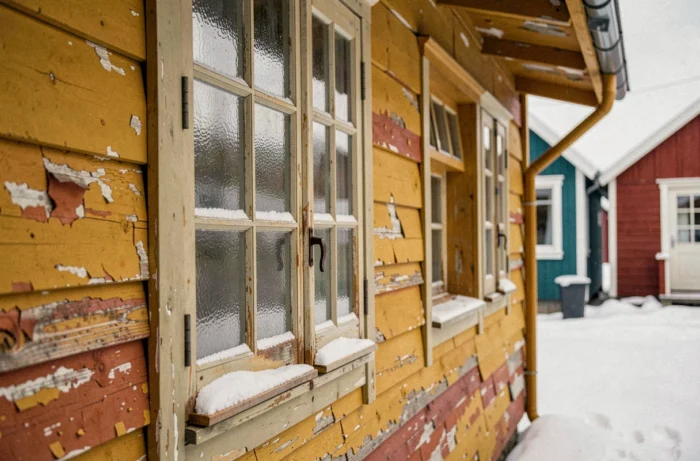
To better understand this unique architectural heritage, the colorful houses of Greenland testify to a legacy where practical constraints and visual identity merge.
Color code of buildings: what each shade indicated
The tradition was to assign a specific color based on the function of the place or the occupation of the occupant. This system, imported by the Danish colonial administration, served as a reference in villages lacking signage.
- Red: reserved for teachers, merchants, and administrative buildings. It is the most common color on Greenlandic facades.
- Yellow: assigned to doctors and medical staff, allowing for quick identification of a place of care.
- Blue: designated the homes of fishermen and activities related to the sea.
- Green: associated with telecommunications buildings and, in some villages, mechanical workshops.
This code never functioned as a uniform rule applied everywhere in the same way. The correspondences between color and function varied by locality and time. Some villages strictly adhered to the Danish grid, while others adapted or partially ignored it.
Today, the functional dimension of the palette has largely disappeared. Residents freely choose the color of their homes, but historical shades remain dominant in the landscape. The visual persistence of the code is less about obligation and more about a cultural attachment passed down through generations.
Orientation and survival: the practical role of colors in a polar environment
The climatic conditions of Greenland, with prolonged winters, frequent snowstorms, and long periods of polar night, made orientation in the villages particularly difficult. The colored facades served as visual landmarks when snow covered the paths and visibility dropped to a few meters.
This color-based navigation system preceded any modern signage. In a coastal village battered by blizzards, distinguishing the doctor’s house (yellow) from the merchant’s (red) could be a matter of life and death. The bright paint compensated for the absence of streetlights and directional signs in isolated communities.
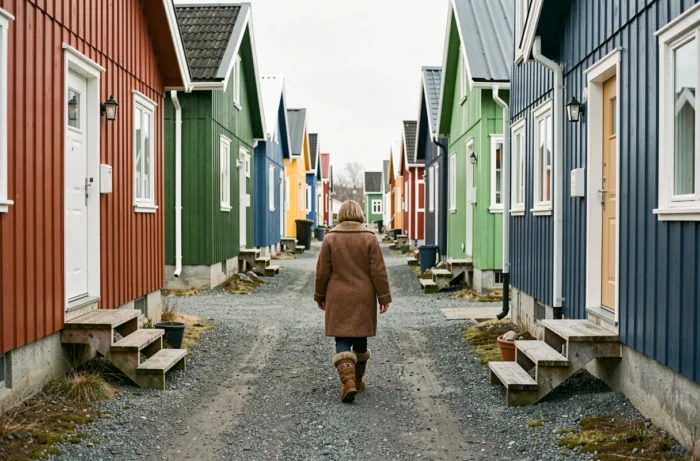
The practical function has faded with the advent of public lighting and road infrastructure, but the logic remains evident in Greenlandic urban planning. The villages maintain a saturated palette that contrasts with the gray of the rock and the white of the ice, a heritage that has become both a visual signature and a climatic response.
Nordic tradition and Greenlandic identity: a shared heritage
The practice of painting houses in bright colors is not unique to Greenland. It can be found in Norway, Iceland, the Faroe Islands, and some Danish cities. It is an architectural trait common to the entire Nordic world, linked to similar constraints: harsh climates, wooden homes, and the need for navigation.
In Greenland, this tradition imported by Danish colonists has taken on its own identity dimension. The villages of Ilulissat, Sisimiut, or Tasiilaq have become iconic images of the country, reproduced in tourist materials and documentaries. The color of the facades now functions as a Greenlandic cultural marker, distinct from its Scandinavian origin.
The interiors of the houses often contrast with the apparent simplicity of the exterior. Travelers’ accounts describe warm and spacious spaces designed to withstand extreme temperatures. The colorful exterior appearance says nothing about the interior comfort, which relies on insulation techniques suited to the Arctic climate.
The colorful houses of Greenland condense several centuries of adaptation: an imported material due to the lack of local resources, a functional code that became an aesthetic tradition, and a survival marker transformed into a tourist symbol. The palette has survived the disappearance of its original function, making it one of the rare cases where a utilitarian colonial system has transformed into a cultural heritage claimed by its inhabitants.