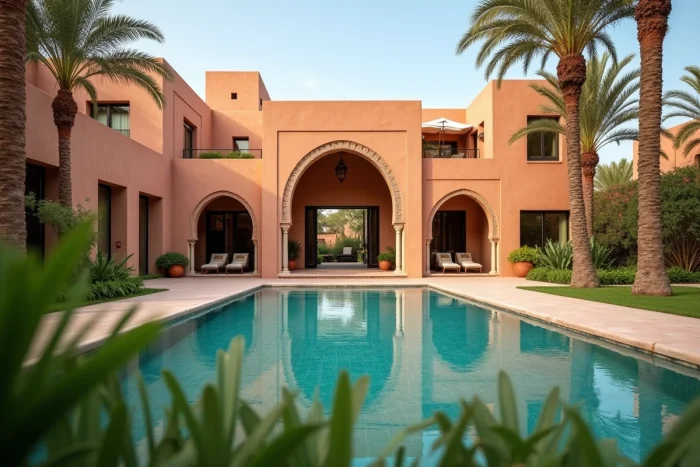
Buying a villa in Marrakech attracts new European investors every year. However, the choice of neighborhood determines a large part of the actual long-term profitability. Amelkis, a gated community adjacent to a golf course, presents an investment profile distinct from other villa areas in the city, with valuation mechanisms that deserve to be detailed.
Villa in Amelkis owned for ten years: what the calculations reveal compared to other neighborhoods
Why compare Amelkis to other neighborhoods rather than looking at it in isolation? Because most content on real estate in Marrakech treats the city as a homogeneous block. In reality, the behavior of a rented villa in Amelkis differs significantly from a property located in a more peripheral villa neighborhood.
Let’s take a common scenario: an investor acquires a villa, occupies it three to four months a year, and rents it out the rest of the time. In Amelkis, the proximity to the golf course and the gated community attract a regular rental clientele, often medium-term stays related to leisure tourism or sporting events. In a peripheral villa neighborhood, rental demand is more concentrated during the high summer season, leaving more pronounced off months.
Over a period of eight to ten years, this rental regularity produces a notable cumulative effect. The villa in Amelkis generates rental income that is better distributed throughout the year, which limits dependence on a single seasonal peak. For an investor looking for villa sales in Amelkis Marrakech with a wealth management perspective, this smoothing of income changes the game compared to a neighborhood where the property remains vacant for six months a year.

Air connections and rental demand: the direct link with the price per square meter in Amelkis
In recent years, direct air links between Marrakech and several European cities have multiplied. This trend has a concrete effect on the local real estate market, and Amelkis captures a disproportionate share of it.
Have you ever noticed that the neighborhoods best served by transportation concentrate real estate demand in all major cities? The same mechanism operates in Marrakech. New low-cost flights from France, Spain, and the UK have expanded the pool of potential tenants for golf villas in gated communities. Amelkis, positioned in this specific segment, benefits from an influx of demand that more distant villa neighborhoods do not capture.
This phenomenon translates into two measurable effects:
- A more stable rental occupancy rate, because the clientele is not limited to July-August vacationers but includes golfers, remote workers, and retirees on extended stays
- An upward pressure on resale prices, fueled by the international visibility of the neighborhood among buyers who directly compare it with the Algarve or Costa del Sol
- A reduction in the risk of long vacancies, with local managers in Amelkis offering comprehensive management packages that reassure non-resident owners
Remote management and residential mix: two underestimated assets of Amelkis
One of the classic barriers to villa investment in Marrakech relates to managing the property from abroad. How to maintain a garden, welcome tenants, manage technical incidents thousands of kilometers away?
In Amelkis, an ecosystem of integrated services reduces this barrier. The gated community structure implies an organized co-ownership, with security, maintenance of common areas, and often referenced service providers for rental management. This level of service does not exist in all villa neighborhoods in Marrakech, where buyers often have to build their own network of service providers.
The other particularity of Amelkis lies in its residential mix. The neighborhood accommodates both permanent residents (retirees, settled expatriates) and seasonal owners. This mix creates a dynamic neighborhood that is lively year-round, unlike some villa areas that empty out of season.
Why does this detail matter to an investor? Because a neighborhood that is permanently inhabited retains its value better at resale. A potential buyer visits a vibrant neighborhood, not a ghost town. Marrakech market professionals cite this residential mix as a factor of wealth resilience, rarely highlighted in general analyses.
Amelkis vs. peripheral villa neighborhood: the factors to compare
Before making a decision, an investor benefits from setting the right comparison criteria. The purchase price per square meter is not enough. Here are the factors that shift the net yield over a decade:
- The actual annual occupancy rate: in Amelkis, rental demand covers a larger part of the year thanks to golf clientele and extended stays
- Co-ownership and management fees: higher in Amelkis, but offset by management peace of mind and the quality of maintenance of the estate
- The appreciation of the property at resale after eight to ten years: gated communities on golf courses have historically shown better price stability than villa neighborhoods without collective amenities
- The actual cost of rental vacancy: each month without a tenant weighs on net yield, and this factor is often underestimated in peripheral neighborhoods
An investor who only compares the entry price risks choosing a neighborhood that is cheaper to buy but significantly less performant over time. The net yield over ten years depends as much on the occupancy rate as on the initial purchase price.
The real estate market in Marrakech continues to attract a diverse international clientele. In this context, Amelkis occupies a particular position: neither the most financially accessible neighborhood nor the most exclusive, but the one whose rental yield and wealth appreciation profile remains the clearest for an investor planning to hold their property for a decade.