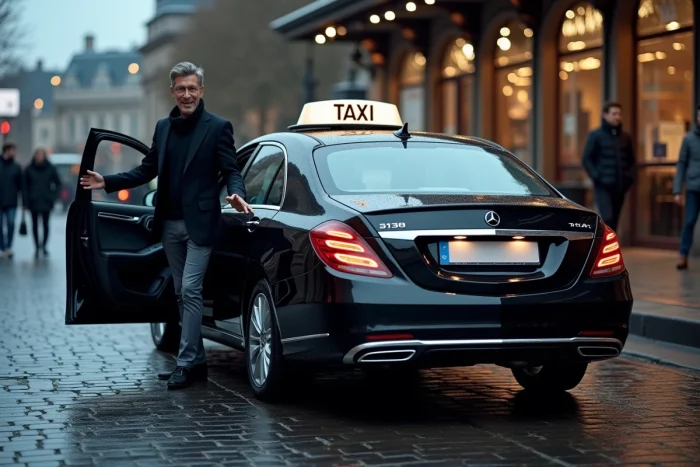
Choosing a vehicle for a taxi or VTC activity commits a driver for several years and several hundred thousand kilometers. The selection criteria go beyond just the catalog price: actual consumption in urban cycles, maintenance costs per kilometer, trunk volume for luggage, and passenger comfort on long journeys.
This article compares the models most used by transport professionals in France and examines how the profession is repositioning itself in light of the scheduled arrival of robotaxis.
Mandatory safety equipment for taxis registered after January 2026
Before comparing models, a recent regulatory parameter changes the game for any new vehicle purchase. Decree No. 2025-1123 of November 15, 2025, requires taxis registered after January 2026 to install 360° cameras and OBD boxes. These equipment, factory-integrated or added post-installation, represent an additional cost that varies by manufacturer.
Recent models from Toyota and Skoda already offer packages compatible with these requirements. For those looking for the best taxi car to discover, this regulatory constraint now weighs as heavily as the engine type or comfort. A non-compliant vehicle at delivery incurs adaptation costs that undermine profitability from the first months.

Comparison of the most used car models by taxis in France
The table below summarizes the characteristics of vehicles favored by professional drivers, distinguishing between urban use and rural or long-distance use.
| Model | Engine Type | Main Use | Distinctive Advantage |
|---|---|---|---|
| Toyota Prius | Hybrid | Urban / suburban | Very low consumption in the city |
| Toyota Corolla Touring Sports | Hybrid | Rural / rough roads | High ground clearance, estate trunk |
| Skoda Octavia | Diesel / hybrid | Versatile | Interior volume, native OBD compatibility |
| Mercedes Classe E | Diesel / plug-in hybrid | Long distance, premium clientele | Passenger comfort, brand image |
| Peugeot 508 SW | Plug-in hybrid | Urban and interurban | Generous trunk, good price/equipment ratio |
The Toyota Prius remains the most common choice in urban areas. Its reliability over several hundred thousand kilometers has been documented by driver feedback for over fifteen years.
Toyota Corolla Touring Sports: the choice for rural taxis
A survey by FNTR on taxi mobility outside urban areas (February 2026) highlights a growing preference for raised estates among drivers in rural areas. The Toyota Corolla Touring Sports offers sufficient ground clearance for rough roads, a point that comparisons focused on Parisian use generally overlook.
Its estate-type trunk facilitates loading of folding wheelchairs or bulky luggage, two common situations in contracted medical transport.
Skoda Octavia and regulatory compliance
The Skoda Octavia stands out for its above-average interior volume for its category. Recent versions natively integrate an OBD box compatible with the requirements of the 2025 decree, avoiding the additional cost of post-installation.
However, its residual value remains lower than that of Toyota in the professional used car market, a factor to consider in the five-year profitability calculation.
European benchmark: hybrid Mercedes and the taxi market in Germany
The French market does not operate in a vacuum. According to ADAC statistics published in April 2026, hybrid Mercedes Classe C represent 40% of the German taxi market since 2025. This figure exceeds the share of Toyota Prius across the Rhine.
The explanation lies in the structure of the German market: average trips are longer, the business clientele is more present, and subsidies for purchasing plug-in hybrid vehicles are higher. For a French driver primarily making long-distance trips or transporting premium clientele, this benchmark deserves attention.
Conversely, for a Parisian urban taxi that handles short rides with frequent stops, the non-rechargeable hybrid from Toyota retains an advantage in actual consumption.
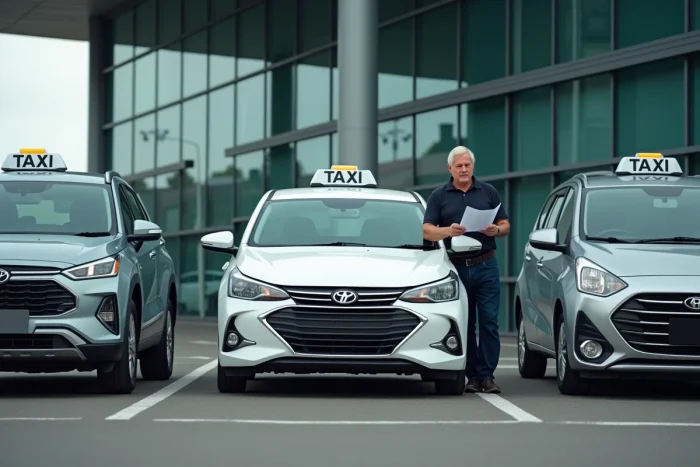
Taxi reconversion in the face of robotaxis: PMR transport and long-distance trips
Waymo has surpassed 500,000 rides per week in the United States. In Europe, autonomous taxis have begun operating in Zagreb, and the Verne project is preparing deployments in several cities. The question for independent taxis is no longer whether robotaxis will arrive, but when they will capture a significant share of standardized rides.
The niches that are difficult to automate shape the reconversion strategy:
- Transport of persons with reduced mobility (PMR): handling wheelchairs, assisting with boarding, adapting the vehicle. These tasks require human intervention that robotaxis do not cover at this stage.
- Long-distance trips with bulky luggage or animals, where a driver’s flexibility (unscheduled stops, route changes) remains a competitive advantage.
- Contracted medical transport CPAM, which involves a trust relationship with the patient and knowledge of care protocols.
The choice of vehicle fits into this logic of specialization. A taxi focused on PMR transport needs a van or a minibus equipped with a ramp, not a compact sedan. A driver oriented towards long distances will prioritize rear seat comfort and fuel tank autonomy.
Minibuses and vans for group passenger transport
For drivers targeting group transport (airport transfers, seminars, tourism), eight or nine-seat minibuses represent a distinct market. The most common models remain the Mercedes Vito, Ford Transit Custom, and Renault Trafic SpaceClass. The determining criterion here is not consumption but seat modularity and comfort on trips longer than an hour.
The profitability of a minibus depends on the occupancy rate. A nine-seat vehicle that operates with an average of two passengers does not cover its costs. Specializing in a recurring clientele (CPAM conventions, corporate contracts, tourist circuits) remains the viable business model for this segment.
The taxi market is fragmenting between short urban rides, likely to be partially captured by autonomous vehicles, and niche services where human interaction and driver adaptability remain irreplaceable. The vehicle is no longer just a transport tool: it reflects a commercial positioning. Hybrid sedan for standard rides, raised estate for rural areas, adapted van for PMR. Each segment dictates its own specifications.