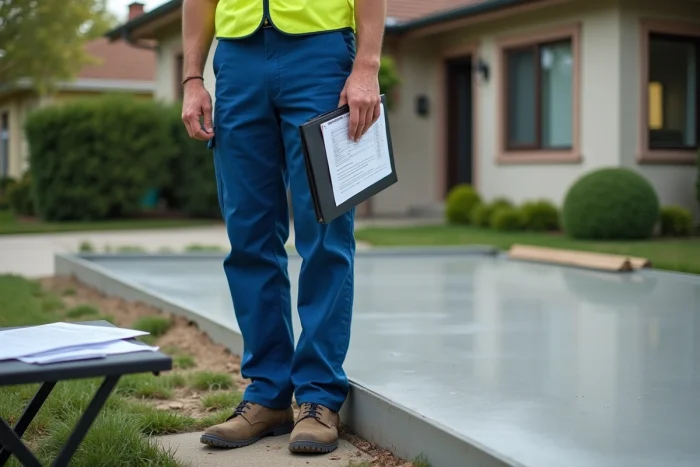
The tax administration has never needed walls to feel at home: a well-laid concrete slab is enough to trigger an immediate reassessment of property tax. Add a few solid square meters to the ground, and suddenly, the tax line thickens. From 5 m² onwards, the axe falls: here, every detail counts, and the administration is watching closely.
As soon as a concrete slab is laid on a plot of land, the fiscal balance is upset. Everything is examined: installation technique, surface area, ground connection, every criterion is weighed by the administration. Very quickly, these simple works acquire the status of built dependencies and fall under the sharp gaze of local taxation. Ignoring these rules means accepting the risk of sharp adjustments. It is better to know what to expect before handling the concrete mixer.
Concrete terrace: procedures, regulatory thresholds, and impact on local taxes
Building a concrete terrace promises solidity and simplicity. The trap? As soon as the project gains a bit of scale, it attracts the sharp eye of the tax authorities. If the slab is limited to less than 5 m², simply laid on the ground and without a roof, complications are rare. However, a larger surface area, elevated or protected, immediately awakens regulations and their consequences on your tax bill.
The Local Urban Planning Plan (PLU) spares no one: height, materials, distance from the roadway, everything is set in black and white. Ignoring it exposes one to unpleasant reminders. To study each implication in detail, refer to the declaration of a taxable concrete slab.
Here are the main scenarios that should catch your attention:
- Ground-level slab and not covered: generally, no procedure is required, as long as the PLU prescriptions are respected.
- Elevated slab or under shelter: declaration to the town hall is mandatory, and often, the tax effects follow closely.
- Surface exceeding 5 m²: declaring the construction becomes systematic, there are no exceptions.
Omitting these procedures exposes you to concrete complications: work stoppage, retroactive taxation, or even various penalties. And the administration never forgets.
Declaration procedure for a concrete slab: the town hall as a necessary step
A concrete slab that is permanently integrated into the landscape necessarily involves a detour to the town hall. We are talking about a complete file: plans, detailed description, measurement reports. The urban planning service compares your project to the PLU and checks every detail, including the visual impact and good neighborly relations.
In theory, the response arrives within a month. After this period, the agreement is deemed granted, but obtaining written authorization remains much more reassuring in case of future discussions.
Before you start, consider these fundamental points:
- If the surface exceeds 5 m², the declaration is mandatory.
- Elevated or protected slab: municipal approval is non-negotiable.
- Some PLUs are more demanding: a look at the regulations avoids unpleasant surprises.
Minimizing the surface area in your application or trying to soften the reality amounts to taking unnecessary risks: control commissions, work stoppage, and tax liabilities to catch up. Accurately declaring the project also allows, later on, to support the valuation of a property during a future sale.

Concrete slab: development tax and property tax, what concrete impact?
For local taxes, every concrete slab counts. Every square meter adds to the taxable base, increasing the final bill. Downplaying the stakes has never protected one from a tax audit or avoided late adjustments.
The first consequence is the amount of the development tax: from 5 m² of surface area or an elevation exceeding 1.80 meters, the tax applies. Its calculation depends precisely on the size, use, and location of the construction. The agreement issued by the town hall triggers the billing, and there’s no escaping it.
Next comes the property tax, reassessed with every new declared square meter. Any extension or recorded slab increases the cadastral value of the property and boosts local taxation.
The direct effects of a concrete slab can be summarized simply:
- Increasing the built surface area mechanically leads to a rise in property tax.
- Validation of the project at the town hall triggers the application of the development tax.
- A property that is enlarged and regularized increases in value on the market, impacting taxation as well.
There is no undetectable slab: aerial photography, vigilant neighbors, or visits from agents, everything eventually comes to light. Taking the time to declare is to avoid troubles and prevent unpleasant tax surprises. Because, sooner or later, even the most discreet slab ends up on the long list of constructions spotted by the administration, right at the moment you least expect it.