
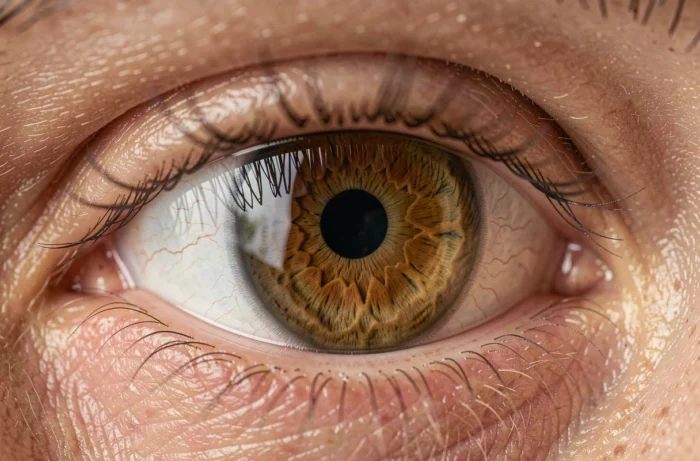
Hazel eyes defy simple classifications. Neither green, nor brown, nor golden, they combine these shades in an iris whose appearance varies depending on lighting and environment. Their supposed rarity and the spiritual interpretations surrounding them are based on precise biological mechanisms, but also on vague cultural criteria. What do we really measure when we talk about the color of hazel eyes, and what do the meanings attributed to them rely on?
Melanin and Light Diffusion: What Produces the Hazel Hue in the Iris
The hazel color does not correspond to any specific pigment. The human iris contains only melanin, which comes in eumelanin (brown) and pheomelanin (yellow-red). What distinguishes a hazel iris from a brown or green iris is the irregular distribution of melanin in the layers of the iris.
The perceived green and golden hues are largely optical effects. The diffusion of light in the stroma (connective tissue of the iris) produces reflections that vary according to the angle of observation. A hazel iris may appear hazel indoors, lean towards olive green under natural lighting, or display golden reflections in direct sunlight.
This variability does not indicate a physical change in the iris. The distribution of melanin remains generally stable after ocular development. The perceived variations arise from visual contrasts: the color of worn clothing, ambient light intensity, the shade of makeup around the eyes. The phenomenon is comparable to how the same fabric seems to change color depending on whether it is placed under neon lights or near a window.
People who wonder about the spiritual meaning of hazel eyes often start from this changing appearance to read a symbolism of transformation or duality.

Hazel Eyes and Genetics: Why the Color Defies Simple Models
The school model that attributes eye color to a single dominant or recessive gene is outdated. The hazel hue is a polygenic trait: many genes simultaneously contribute to the production, transport, and storage of melanin in the iris.
Two genes play a predominant role: OCA2 and HERC2, located on chromosome 15. Their interaction largely determines the amount of melanin produced. In contrast, other genetic loci modulate the spatial distribution of the pigment, which explains the concentric or star-like patterns often visible in hazel irises.
| Factor | Role in Hazel Color |
|---|---|
| Eumelanin (moderate amount) | Produces the brown base of the iris |
| Pheomelanin | Provides yellow-golden hues |
| Irregular distribution in the stroma | Creates green areas through light diffusion |
| OCA2/HERC2 genes | Regulate overall melanin production |
| Multiple modifier genes | Influence the spatial distribution of the pigment |
This genetic complexity explains a common fact: two brown-eyed parents can have a hazel-eyed child, and vice versa. A child’s eye color cannot be deduced simply by combining the parental colors.
Rarity of Hazel Eyes: An Impossible Figure to Fix
Articles that assign a specific percentage to the prevalence of hazel eyes in the global population simplify a real methodological problem. There is no universal definition of the “hazel” category.
Several obstacles make measurement difficult:
- The boundary between hazel, green, amber, and light brown depends on subjective visual criteria, not a measurable biological threshold
- Classifications vary by country and medical traditions: what an American ophthalmologist calls “hazel” may be classified as “hazelnut” or “green-brown” elsewhere
- The appearance of the iris changes according to lighting conditions at the time of observation, introducing bias into any attempt at standardized counting
What is established is that irises with little melanin (blue, green, hazel) are significantly less common than brown irises on a global scale. The majority of the human population has dark brown eyes. Hazel eyes fall into an intermediate pigmentation zone, more common in populations of European or West Asian descent.
Hazel Eyes and Ocular Risks: What Medical Literature Reports
The color of the iris is not just an aesthetic or spiritual matter. Epidemiological literature reports a link between light-colored irises and an increased risk of uveal melanoma. Hazel irises, situated in the range of intermediate to light pigmentation, fall into this category.
The presumed mechanism is logical: less melanin in the iris means less filtering of ultraviolet rays that penetrate the eye. This data does not mean that every person with hazel eyes will develop an eye problem, but it justifies wearing UV-filtering sunglasses, especially during prolonged exposure.
Hue of the Iris and Light Sensitivity
People with hazel eyes often report increased sensitivity to bright light compared to those with dark brown eyes. This phenomenon, consistent with the intermediate level of melanin in their iris, remains variable from one individual to another.
Symbolism of Hazel Eyes: Between Cultural Perception and Spiritual Projection
The spiritual interpretations associated with hazel eyes are based on their most visible characteristic: a gaze that seems to change color depending on the context. This optical property has fueled symbolic readings in several traditions.
The recurring association between hazel eyes and “duality” or “balance” directly stems from the coexistence of warm (brown, golden) and cool (green, gray) shades in the same iris. In some esoteric traditions, this coexistence is interpreted as a sign of a personality capable of navigating between opposing registers.
These readings remain cultural projections, not measurable facts. No study establishes a link between iris color and personality traits. The fascination with hazel eyes is more about their relative rarity and changing appearance than any verifiable property of their bearers.
Eye color remains a genetic marker whose biological complexity far exceeds common classifications. Hazel eyes, with their mix of melanin and optical effects, illustrate how a physical characteristic can generate both open scientific questions and enduring symbolic narratives.