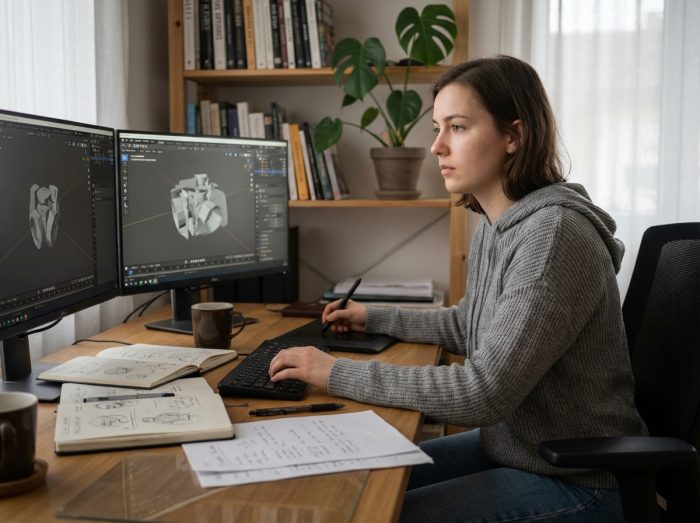
Abandon strikes more than one beginner after a few weeks of learning. The first technical successes rarely produce the desired effect, and the progression curve remains uneven, even for the most diligent. Methodological errors often accumulate due to a lack of clear benchmarks, hindering long-term motivation.
Some professionals admit to having taken years to overcome these stages, lacking structured tools or appropriate advice. However, solutions exist to overcome each hurdle without losing the thread or the desire. The key steps for a smoother progression rely on methodical choices and targeted access to the right resources.
Why 3D animation can seem discouraging at first
Diving into 3D animation often means confronting a bustling technical universe. From the very first attempts, a feeling of dispersion sets in. Between the multitude of tools and the complexity of modeling software, it is not uncommon to feel a sense of disorientation. The interface seems labyrinthine, functionalities pile up, and the list of shortcuts grows endlessly. This abundance, far from reassuring, can heighten the apprehension of novices.
On top of that, there is the confrontation with motion and the requirement for a polished visual experience. Each project demands juggling with light, textures, animation, and adherence to visual identity. Expectations, particularly in France, are high: approximation has no place. To grasp all these parameters, time is needed, but also a good dose of perseverance.
The reality of the time required to progress in 3D animation quickly becomes apparent, far from the promise of instant results. Sometimes, one must wait before seeing tangible advances, which leads to frustration and self-doubt. Progress does not follow a straight line: it alternates between moments of intense satisfaction and periods of uncertainty. In front of each mistake, each disappointing render, motivation wavers.
However, this learning journey develops a precise understanding of the stakes related to technology and storytelling through images. Developing one’s skills is not just about mastering commands: it is also about taming patience and accepting a path marked by obstacles, but also by stimulating discoveries.
What key steps facilitate regular progress in motion design
To structure a solid approach, start by clarifying your motion design objective. Define exactly the nature of your motion design project: is it an institutional video, an advertising sequence, or an educational module? Taking this time for reflection helps guide the choice of tools and graphic processes. Writing a brief, even concise, helps anticipate constraints and maintain visual coherence throughout the project.
The creation phase then relies on a thoughtful selection of visual elements. The color palette must align with the visual identity and enhance the overall impact. The animation itself must remain accessible and clear: multiplying complicated effects can muddle the message and harm the user experience.
Here are the work steps to structure for effective progress:
- Storyboard or animatic to set the pace and anticipate key transitions;
- Setting up graphic elements, followed by a thoughtful sequence of different scenes;
- Regular tests with a focus group to adjust readability and visual ergonomics as you go.
Throughout the project, formative evaluation allows for progress: critically examine each render, identify what works or what hinders, and seek to understand why attention wanes at certain moments. Motion design challenges habits: one must accept to question their choices, refine their methods over experiences. This learning, project after project, builds a sharper eye and lasting reflexes.

Resources, training, and advice to avoid common mistakes
Advancing in 3D animation often involves a structured professional training. Favor courses eligible for CPF to benefit from a solid educational framework and personalized support. This approach limits the risks of dispersion and strengthens motivation, where a solo journey can quickly lead to scattering.
Social media also play a driving role. By sharing your creations, seeking feedback, or dissecting trends, you benefit from the energy of a community. The engagement goal on social networks encourages perseverance and sharpens critical analysis, far from the solitude faced in front of a screen.
Learning is also nourished by up-to-date educational resources: tutorials, webinars, specialized articles. It is useful to identify content that highlights common pitfalls, whether it is about managing import errors, configuring modeling software, or improving workflow. An active watch on industry news in France brings fresh insights at every stage.
To strengthen your approach, keep in mind these few levers:
- Adjust training according to your target audience: each project addresses specific expectations.
- Vary learning formats: videos, articles, interactive workshops to deepen understanding.
- Integrate the right to make mistakes into your progress: each failure brings experience that serves the future.
Staying the course relies on consistency, listening, and dialogue with other practitioners. This is how difficulties become springboards, and 3D animation ceases to be a labyrinth to assert itself as a playground where each well-marked step opens up new perspectives.