
Game design attracts people who have never touched a game engine before their thirties. Architects, teachers, data analysts and ergonomists: these backgrounds are now bringing new skills to studio teams in France and beyond. The question is not whether a career change into game design is possible, but what each professional background concretely brings to the role—and what it does not cover.
Transferable skills for game design: what job postings really ask for
Recent job postings make it possible to map the skills employers expect and compare them with the experience gained in several other professions. A Senior Game Designer posting for Beyond Good & Evil 2, published in October 2026, highlights rapid prototyping, iteration, documentation and collaboration with technical, art and AI teams. At Voodoo, a mobile Game Designer role requires expertise in game balancing and player behavior analysis.
These requirements point to a hybrid skill set. Here is how several professional backgrounds measure up:
| Previous profession | Directly transferable skills | Skills to develop |
|---|---|---|
| UX designer / ergonomist | User research, prototyping, iteration, testing | Gameplay balancing, game engine tools (Unity, Unreal) |
| Developer / programmer | Technical prototyping, scripting, systems logic | Interactive storytelling, level design, player perspective |
| Teacher / trainer | Learning progression, storytelling, explaining complex ideas clearly | Prototyping, technical tools, in-depth video game knowledge |
| Data analyst | Behavioral analysis, metrics, A/B testing | Mechanics design, writing game design documents |
| Architect / industrial designer | Spatial thinking, 3D modeling, ergonomics | Gameplay programming, game economy |
The table reveals one thing these backgrounds have in common: none covers the full range of skills. Every career change involves filling a gap, usually on the technical or creative side, depending on the person’s background.
It is entirely possible to get started in game design without attending a computer science school by building on these transferable skills, provided you create a playable portfolio.
The game design job market in France: a changing landscape for career changers
The French video game market presents a paradox. Revenue reached €5.856 billion in 2025, but job postings in the sector reportedly fell from 2,716 in 2022 to 799 in 2025, according to data cited by Le Nouvel Économiste from the AFJV. The contraction is significant.
For someone changing careers, this changes the strategy for entering the industry. An unconventional background based solely on motivation or a general degree is no longer enough. Studios—especially smaller French studios going through a difficult period—are hiring people who can deliver measurable results within their first few months.
What this means for career changers
- A portfolio matters more than a CV: even a rudimentary playable prototype demonstrates production skills that a degree alone cannot prove
- Analytical skills (data, metrics, player behavior) are in demand in mobile and free-to-play game design, segments that are hiring more than AAA in France
- Interdisciplinary communication, highlighted in recent job postings, gives candidates from project management, teaching or consulting an advantage
By contrast, candidates from purely technical fields (backend development, infrastructure) need to demonstrate an instinct for gameplay that may not be obvious from their previous experience.
Mobile and analytics-focused game design: the segment that values career changers most
Game design is not a single, uniform field. The mobile and free-to-play segment hires for different skills than narrative-driven console or PC games. The Voodoo posting mentioned above illustrates this focus: balancing, behavioral analysis and product optimization carry more weight than art direction or storytelling.
A data analyst moving into mobile game design has a structural advantage. Reading retention curves, segmenting players and understanding monetization mechanics are already part of their professional routine. The gap to bridge is gameplay loop design—a skill developed through practice and prototyping.
Prototyping and game jams: a training ground for unconventional backgrounds
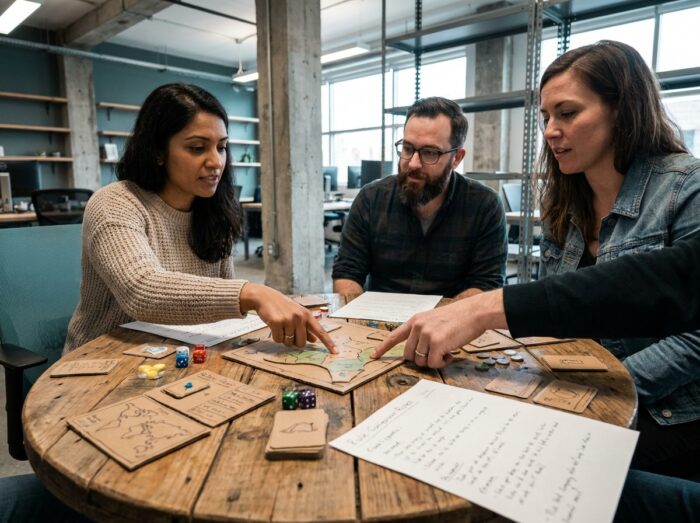
Game jams (time-limited game creation events, often lasting 48 hours) are one of the most accessible ways to test the waters when changing careers. They let participants test a gameplay idea, work in a multidisciplinary team and produce something they can show to others. For someone with an unconventional background, three to five documented game jams are worth more to a studio recruiter than a theoretical course.
Regular prototyping in Unity or Unreal Engine, even outside game jams, builds a portfolio that speaks the studios’ language. Recruiters look for evidence of an ability to iterate: a rough first prototype improved over three successive versions tells a more compelling professional story than a single, overly polished project.
Changing careers into game design: paths that work and those that stall
The smoothest career changes have one thing in common: the previous role already involved designing an experience for a user. UX designers, architects, screenwriters and teachers think in terms of journeys, progression and friction. This vocabulary carries over to game design without a major conceptual leap.
By contrast, career changes tend to stall when candidates have to learn to think in terms of gameplay and master a technical tool at the same time. An accountant who loves video games will have two hurdles to clear instead of one, lengthening the transition and reducing the chances of being hired quickly in a contracting market.
The defining market figure remains the same: fewer than 800 job postings a year in France across the entire video game sector. In this context, an unconventional background needs to translate into a clearly identifiable specialization (level design, game economy, gameplay UX) rather than a generalist “jack-of-all-trades” profile. Studios hiring are looking to fill a specific need, not train someone into a complete game designer.