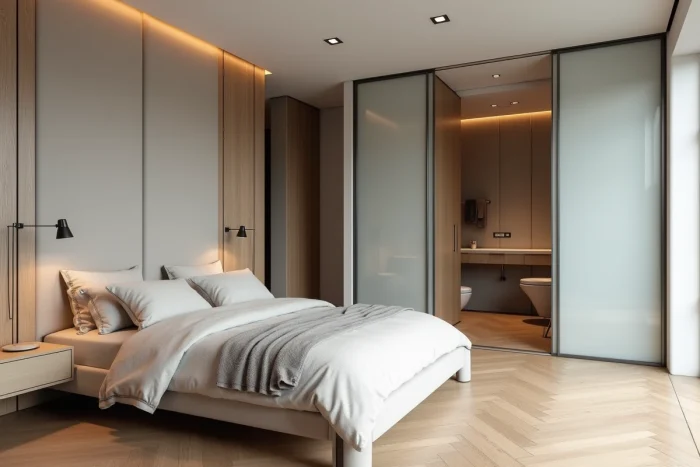
In 15 m², a master suite is not just about fitting in a bed, a wardrobe, and a shower. The real challenge lies in the choices of circulation, partitioning, and anticipating uses in ten or twenty years. We see too many plans that maximize storage at the expense of actual livability, the kind that allows one to age in place without needing renovations.
Accessibility and Aging: The Master Suite Plan Designed to Last
A 15 m² master suite layout designed solely for storage becomes a medium-term trap. The demand for accessible or adaptable suites is significantly increasing among architects, even in modest spaces, in anticipation of aging in place.
The circulation around the bed dictates the rest of the plan. We recommend a clear passage of at least 80 cm on each side of the bed, rather than the 50 cm often presented as sufficient. This width allows for the passage of a walker or wheelchair when the time comes, without sacrificing the space perceived today.
To design a 15m² bedroom plan with a dressing area that stands the test of time, one must think in scenarios: a couple in good health at forty, a person with reduced mobility at seventy. Floor level changes between the bedroom and the bathroom should be avoided from the outset. A walk-in shower costs no more than a raised shower tray, and it eliminates the main domestic fall hazard.
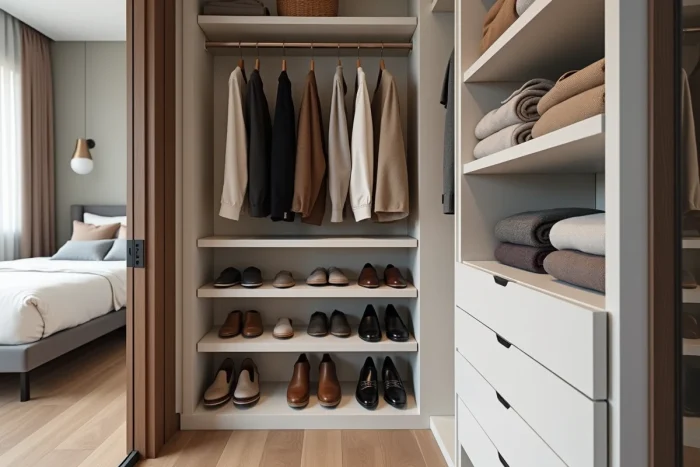
Specifically, this means that the partition between the sleeping area and the bathroom should favor a wide opening (sliding pocket door or removable partition) rather than a 63 cm swinging door. A sliding pocket door frees up the entire passage without encroaching on the usable space of the bedroom or the bathroom.
Multifunctional Headboard: The Divider That Replaces Partitioning
High-end hospitality professionals have long used the headboard as a structuring element of the room. This approach is still rarely adopted in master suite plans for private individuals, even though it simultaneously solves several problems in 15 m².
The principle: a thick headboard (between 35 and 45 cm deep) that incorporates niches on the bed side and shelves or wardrobes on the dressing side. It acts as a light partition without building a wall, maintaining natural light and ventilation throughout the room.
- On the sleeping side: built-in bedside niches, integrated USB outlets, indirect lighting. Nightstands are eliminated, freeing up lateral circulation.
- On the dressing side: a hanging rod across the full width, shelves at variable heights. A depth of 40 cm is sufficient for standard hangers.
- At the top: closed storage (duvets, seasonal pillows) accessible from the dressing side, invisible from the bed.
This structuring headboard replaces both a partition, two nightstands, and part of the dressing area. In 15 m², every centimeter of lost traditional partition thickness (about 7 to 10 cm in total) is costly. A custom headboard offers the same visual separation with useful, not wasted, space.
Integrated Dressing Area in 15 m²: Balancing Storage Volume and Usability
We observe a strong trend towards full-height integrated storage rather than freestanding wardrobes. In 15 m², this is the right direction, provided the bedroom does not turn into a corridor of closets.
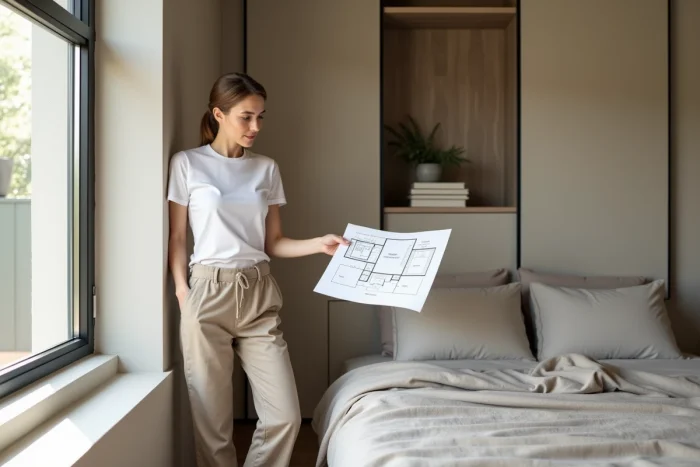
A linear dressing area of 250 cm long by 60 cm deep occupies 1.5 m² of floor space. Placed against the longest wall, it leaves a comfortable circulation axis in front of the bed. Placed in a return corner, it gains capacity but creates a bottleneck if the room is less than 3 m wide.
- Linear configuration (long wall): the safest way to maintain 80 cm of passage. Suitable for classic rectangular rooms.
- L-shaped configuration: more storage, but requires checking that the corner does not block access to the bed or bathroom.
- Configuration behind the headboard: utilizes the room’s depth, separates sleeping and storage without a partition, but requires a room length of at least 5 m.
The classic trap: dressing room sliding doors that, once opened, reduce the passage to less than 60 cm. Prefer sliding doors that overlap rather than hinged doors, and check the residual width when open, not just when closed.
Integrated or Adjacent Bathroom: What 15 m² Really Allow
On this surface, integrating a complete dressing area and a bathroom within the same 15 m² envelope remains technically possible, but at the cost of heavy compromises on circulation. We recommend treating the bathroom as an adjacent volume (accessible directly from the bedroom) rather than included in the 15 m², unless the room length exceeds 5 m in the axis of the bed.
When the bathroom is integrated, a walk-in shower without a step remains the only coherent choice for an adaptable plan. An ultra-flat shower tray with a slope of 1 to 2% towards the drain is sufficient to ensure drainage without creating a step. A walk-in shower is a choice of accessibility, not just aesthetics.
For ventilation, a bathroom without a window integrated into the bedroom requires an efficient mechanical ventilation system. Without proper extraction, moisture migrates to the dressing area, textiles, and bedding. This technical point is often overlooked in layout plans that focus on optimizing square meters.
The most successful 15 m² master suite is not the one that contains the most functions, but the one where circulation is effortless, today and in twenty years. It is better to have a slightly more compact dressing area and generous circulation than a saturated plan that will require a complete overhaul at the first mobility accident.