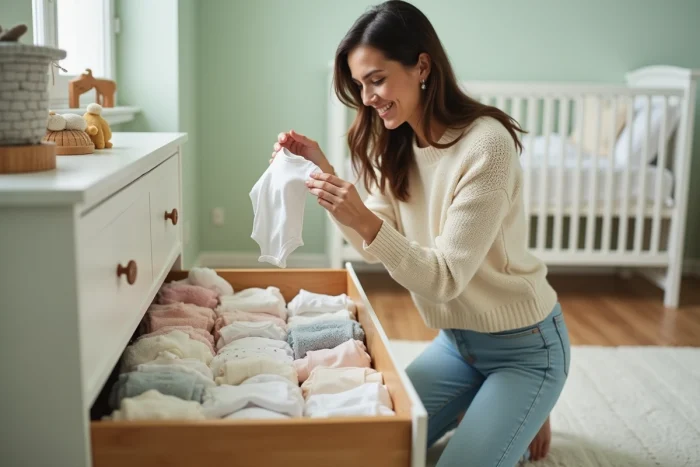
How many bodysuits, pajamas, and sleep sacks should you really have in the drawers when an infant changes size every few weeks? The answer depends less on an ideal list than on the growth rate specific to each child and the frequency of laundry in the household. This article measures the differences between age groups to determine the useful volume of baby clothes at each stage.
Usage Duration by Size: The Game-Changing Chart
The most critical data for sizing an infant’s wardrobe is the duration for which each size is actually worn. A newborn size bodysuit is only useful for a few days for an average-sized baby, while a 6-month size can remain suitable for two to three months.
| Clothing Size | Indicative Age Range | Average Usage Duration |
|---|---|---|
| Newborn (50 cm) | 0 – 3 weeks | A few days to 3 weeks |
| 1 month (54 cm) | 3 weeks – 2 months | 3 to 6 weeks |
| 3 months (60 cm) | 2 – 4 months | 6 to 8 weeks |
| 6 months (67 cm) | 4 – 7 months | 2 to 3 months |
| 9 months (71 cm) | 7 – 10 months | 2 to 3 months |
| 12 months (74 cm) | 10 – 14 months | 3 to 4 months |
| 18 months (81 cm) | 14 – 20 months | 4 to 6 months |
This chart highlights a clear imbalance. The newborn and 1-month sizes accumulate barely two months of use, while from 6 months onwards, growth slows down and each size lasts significantly longer.
This gap is what you need to calibrate your purchases. Investing in ten newborn bodysuits means accumulating unused laundry, while the same quantity in size 6 months will be worn daily for several weeks. To better understand the quantity of baby clothes by age, you should think in terms of actual usage days rather than the number of pieces per category.
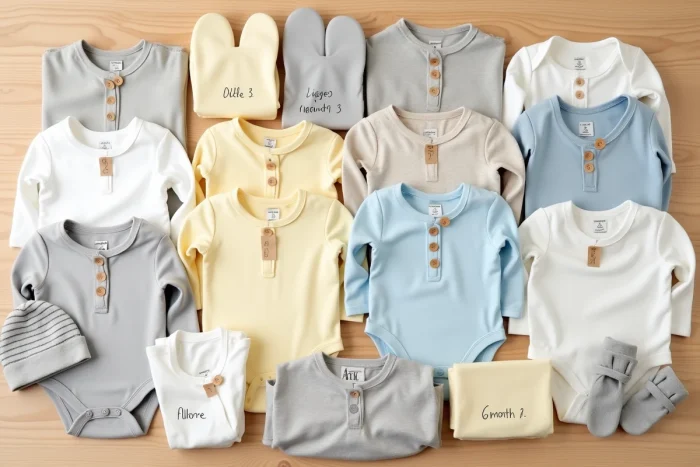
Number of Pieces by Age Group: Thinking in Terms of Laundry Frequency
The volume of clothing to have at any one time depends on a simple household variable: laundry frequency. A household that washes every two days does not have the same needs as one that consolidates laundry over the week.
Basic Pieces for Quick Rotation Sizes (Newborn to 3 Months)
- Bodysuits (long or short sleeves depending on the season): 5 to 7 pieces are sufficient if laundry is done every two to three days, as an infant can dirty two to three bodysuits per day due to spit-ups and diaper changes
- Pajamas: 4 to 5 pieces, preferably with full openings to facilitate nighttime changes
- Sleep sacks: 2 pieces, one in use and one as a backup in case of spit-up
- Hats and socks: 2 to 3 pairs, often lost or soiled during outings
For strict newborn size, reducing this volume by half is reasonable since this size will only be worn for a few days for most newborns weighing around average.
Adjustment for Slow Rotation Sizes (6 to 18 Months)
Starting from size 6 months, the growth rate stabilizes and clothing lasts longer. The wardrobe can then slightly expand in diversity (soft pants, t-shirts, overalls) without increasing the total number of pieces per category.
However, physical wear becomes a factor. A baby who crawls and then walks damages the knees of their pants and the soles of their booties. Planning for two to three extra pairs of pants starting at 9 months compensates for this mechanical wear that previous sizes do not experience.
Baby Clothes and Second-Hand: Adjusting Quantity to Acquisition Mode
The rise of resale and rental of baby clothes in recent years is changing the purchasing logic. The ultra-rapid size rotation in 0-24 months is one of the main drivers of these new services. Several childcare and children’s fashion brands have expanded their second-hand and rental offerings (monthly boxes, size subscriptions) since 2021-2023.
This evolution changes the question: it’s no longer about “how much to buy” but rather “how much to own simultaneously.” A subscription to a rental box typically covers 10 to 15 pieces per size, which corresponds to the useful volume identified above. New purchases are then limited to pieces in direct contact with the skin (bodysuits) and hygiene accessories (bib, sleep sacks).
Baby Textile Waste: The Preventive Stock Trap
Public health organizations and environmental NGOs have pointed out for several years the growing weight of children’s textiles in household waste. Baby clothes are explicitly identified as an easy lever for reduction, due to their very short usage duration and their often nearly new condition when discarded.
Building up a stock “just in case” for the first six months means immobilizing pieces that may never be worn. A baby of above-average size may completely skip the newborn size and go straight to size 1 month. Conversely, a premature baby will wear specific clothes that are absent from standard grids.
Buying in two stages limits waste: a first minimal lot before birth (sizes 1 month and 3 months), followed by an adjustment based on the actual size of the infant in the weeks that follow. This approach avoids ending up with a pile of new clothes never unpacked in newborn size.
The most reliable criterion for sizing the wardrobe remains the birth weight crossed with the frequency of laundry in the household. A baby weighing around average only needs 15 to 20 pieces across all categories for their first four weeks, provided that laundry is done every two to three days.
Once past the 6-month mark, the stabilization of growth allows for an extension of the lifespan of each piece and reduces the overall purchase volume in the second half of the year.