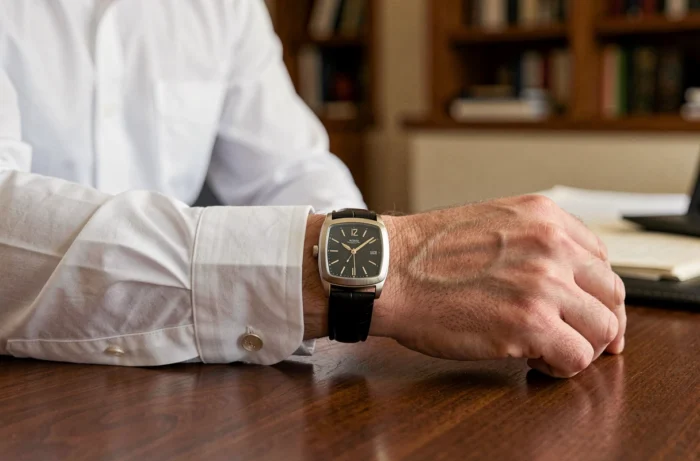
A square watch is defined by a case where the width-to-height ratio approaches 1:1, as opposed to rectangular shapes where the height clearly dominates. This geometry, which emerged in the early 20th century with the Cartier Santos, remains a minority in global watch production.
Research related to rectangular and square cases has, however, increased by 9.3% year-on-year in 2025 on Chrono24, according to the South China Morning Post. This renewed interest warrants a technical look at what truly distinguishes these watches beyond their silhouette.
Square case proportions: what changes for the wrist
A round dial of 40 mm occupies less visible surface than a square case of 38 mm per side. The reason lies in the geometry: the circle inscribed in a square leaves empty corners, while the square utilizes the entire projected surface. At similar nominal dimensions, a square watch thus appears more imposing on the wrist.
This particularity has a direct consequence on comfort. The thickness of the case is as important as the width in determining whether the watch remains discreet under a shirt cuff. Dress models like the Jaeger-LeCoultre Reverso or the Cartier Tank rely on thin cases, often under 10 mm thick, precisely to slide without snagging the fabric.
A rarely discussed point: the lugs of a square watch are shorter than those of an equivalent round case. The strap, whether in leather or steel, attaches closer to the corners of the case. The result is a watch that conforms to the curvature of the wrist differently, with less overhang at the ends. For slender wrists, this is often a clear advantage compared to a round case of comparable diameter.
Among square watches for men, the diversity of proportions ranges from nearly miniature (the NOMOS Tetra with its 29.5 mm per side) to boldly assertive (the Bell & Ross BR 03 at 41 mm). Choosing the right size requires measuring the width of one’s wrist, not just following a trend.

Watch movement and square shape constraints
Almost all mechanical calibers are designed for round cases. Integrating a circular movement into a square case poses a space issue: the corners of the case remain empty, which increases volume without functional benefit. A few manufacturers have developed shaped calibers, designed to occupy the entire available rectangular or square surface.
Jaeger-LeCoultre has equipped its Reverso with rectangular in-house calibers for decades. NOMOS, a Glashütte manufacturer, uses a specific movement adapted to the format in the Tetra. These shaped calibers are more expensive to produce: the tooling is dedicated, the volumes are smaller, and assembly requires adjustments specific to each reference.
TAG Heuer took a different path in 2026 with the Monaco Evergraph in titanium, equipped with the COSC-certified TH80-00 caliber. This movement offers a claimed power reserve of 80 hours. The square shape here serves as a platform for technical innovation rather than a simple vintage homage.
Quartz or mechanical in a square case
The choice between quartz and mechanical does not fundamentally change based on the shape of the case. A quartz movement, being more compact, easily integrates into any geometry. The shaped mechanical caliber remains a marker of high watchmaking, reserved for brands capable of investing in dedicated development.
For a moderate budget, a quartz movement in a well-designed square case offers a profile slimness difficult to achieve with a standard automatic caliber.
Reference square models: three lineages to distinguish
Rather than an exhaustive catalog, three design families deserve to be understood for their distinct technical choices.
- The Art Deco lineage, represented by the Cartier Tank (1917) and the Jaeger-LeCoultre Reverso (1930s). These watches prioritize the slimness of the case, Roman numerals or stick indices, and a leather strap. Their design has not structurally changed since their creation.
- The sporty-square lineage, embodied by the TAG Heuer Monaco (1969) and the Bell & Ross BR 03. Thicker cases, often in brushed steel or titanium, with chronograph functions or graduated bezels. Water resistance is significantly superior to dress models.
- The Bauhaus-minimalist lineage, with the NOMOS Tetra as the central figure. Clean dial, no superfluous complications, emphasis on readability and the quality of finishing of the movement visible through a sapphire case back.
Cartier Santos: between two worlds
The Cartier Santos occupies a unique position. Originally created for aviator Alberto Santos-Dumont, it combines a square case with a screwed bezel and an integrated steel bracelet. It can be worn equally well with a suit or casual attire, placing it at the crossroads of dress and sporty lineages. Its quick-change strap system, without tools, enhances this versatility.
Leather or steel strap: impact on the appearance of a square watch
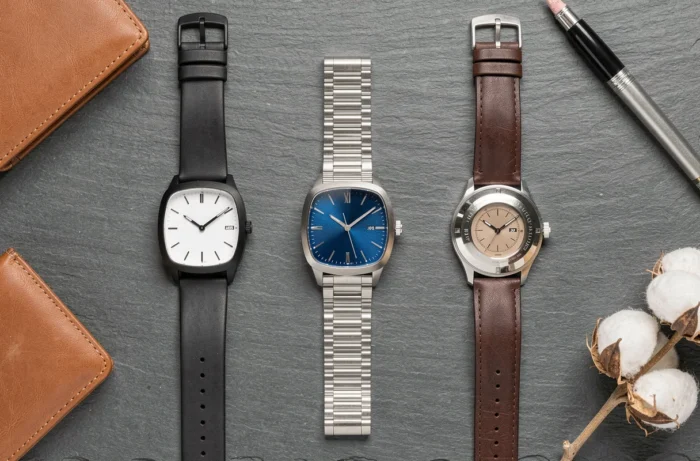
The choice of strap radically alters the perception of a square watch. A leather strap visually slims the whole and directs the style towards the dressy register. An integrated steel strap, with links that extend the lines of the case, gives a more massive and contemporary effect.
On a square case, the integrated steel strap creates a visual continuity that round watches do not achieve in the same way. The Cartier Santos or the Bell & Ross BR 05 exploit this effect: the wrist wears a coherent geometric block rather than a dial set on a strap.
Leather remains the natural choice for slim models. A Reverso on a steel strap would lose part of its historical elegance. Conversely, a BR 03 on soft leather gains lightness without sacrificing its character.
The second-hand market confirms this trend towards dressy silhouettes. Rectangular and square models have fared better than round sporty watches in recent years, according to data reported by the South China Morning Post. The square watch is no longer a niche choice but a measurable growing segment.